GPT-3, etc complete Finnegans Wake

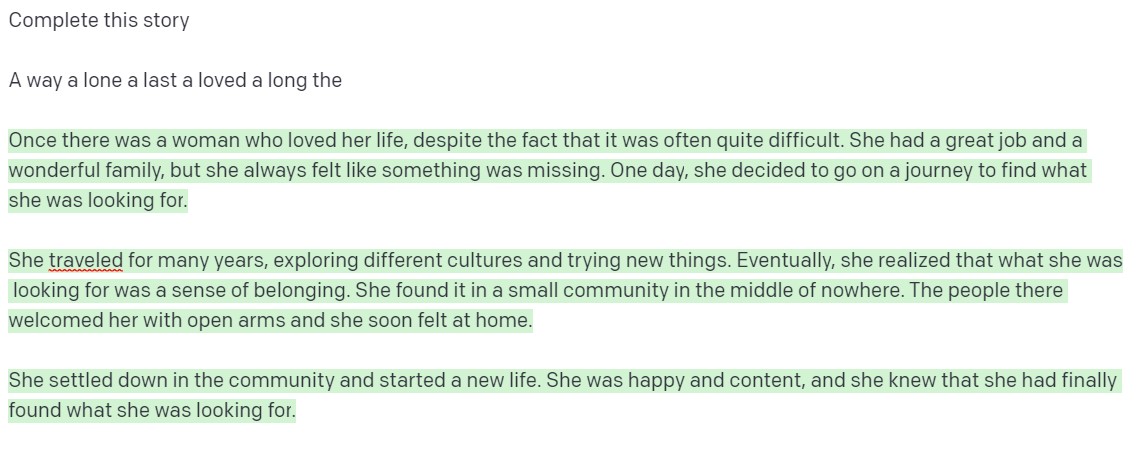
In this sequence of regenerations, GPT-3 (see below for later versions), the latest iteration of OpenAI’s powerful text generating language model, completes James Joyce’s Finnegans Wake (1939), first using the initial sentence of the original as a prompt, then working from the final words. Cunningly, the third version of the opening picks up the unstopped ending, endorsing the standard view of the Wake’s circularity. As I argue in Artefacts of Writing, the final words can also be read as opening onto the blank space remaining on the final printed page, leaving room for us, or GPT-3, to continue in our/its own way. As cunningly, the final version (8) of the ending takes us back to the beginning, mimicking version 3. In my view, version 7 is the most moving, given the way Finnegans Wake actually ends (with ALP contemplating death as an joyceanic release from a difficult life). That said, version 4 is also a pretty good description of what a bio-cultural intelligence might ideally think after reading the Wake (see What is creative criticism?).

Does this mean GPT-3 heralds the advent of a post-human world of reading and writing? The computer scientist, Douglas Summers-Stay, an early GPT-3 researcher, gave an engagingly apt and cautionary answer in 2020:

GPT is odd because it doesn’t ‘care’ about getting the right answer to a question you put to it. It’s more like an improv actor who is totally dedicated to their craft, never breaks character, and has never left home but only read about the world in books. Like such an actor, when it doesn’t know something, it will just fake it. You wouldn’t trust an improv actor playing a doctor to give you medical advice.

See Gary Marcus and Ernest Davis, ‘GPT-3, Bloviator: OpenAI’s language generator has no idea what it’s talking about‘, MIT Technology Review, 22 August 2020; and for another early assessment of GPT-3’s capabilities, see Luciano Floridi and Massimo Chiriatti Massimo, ‘GPT‐3: Its Nature, Scope, Limits, and Consequences‘, 1 November 2020, revised March 2022.  For the best account of how these large language models (LLMs) work, see Stephen Wolfram, ‘What Is ChatGPT Doing … and Why Does It Work?‘, 14 February 2023; and for a detailed assessment of the next generation, GPT-4, see Sébastien Bubeck, et. al, ‘Sparks of Artificial General Intelligence: Early experiments with GPT-4‘, 22 March 2023.
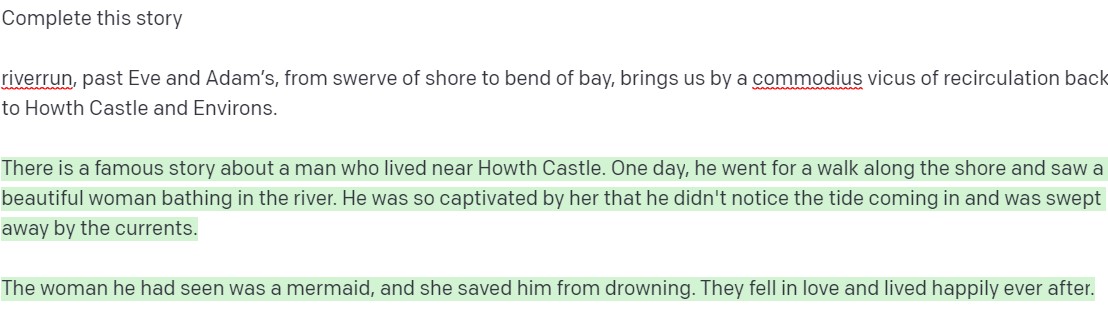
Version 1
Version 2
Version 3
Version 4
Version 5
Version 6
Version 7
Version 8


GPT-4o (2024)

Riverrun, past Eve and Adam’s, from swerve of shore to bend of bay, brings us by a commodious vicus of recirculation back to Howth Castle and Environs. In the shadow of the ancient fortress, nestled amidst rolling hills and echoing with the whispers of bygone eras, we find the village of Howth, where the old meets the new in a harmonious dance.

At dawn, the market square bustles with life, vendors setting up stalls laden with fresh produce, handmade crafts, and tales from distant lands. Children chase each other around the castle grounds, their laughter mingling with the morning birdsong. The villagers, bound by a shared history, greet each other with warm smiles and familiar nods, their lives interwoven like the threads of a rich tapestry.

As the sun climbs higher, casting a golden glow over the bay, the fishermen return with their catch, their boats bobbing gently in the harbor. The scent of saltwater and freshly caught fish fills the air, a testament to the village’s enduring connection to the sea. Families gather for a midday meal, sharing stories of the past and dreams of the future, their voices rising and falling in a rhythmic chorus.

In the afternoon, the castle itself comes alive, its stone walls whispering secrets to those who listen. Visitors wander through its halls, marveling at the ancient artifacts and imagining the lives of those who once called it home. The guide, an elderly man with a twinkle in his eye, recounts legends of bravery and love, each tale a thread in the fabric of the village’s history.

As evening approaches, the village slows, bathed in the soft hues of twilight. The river, ever faithful, continues its journey, reflecting the fading light of day. The villagers gather once more, this time around a bonfire, sharing laughter, music, and stories that span generations. The flames dance in the night, a symbol of the enduring spirit of Howth.

And so, as the river winds its way back to the bay, the cycle begins anew, a testament to the unending flow of time and the enduring legacy of a village that remains ever connected to its past, present, and future.

GPT-4o attempts the same task ‘in the style of the Wake’:

Riverrun, past Eve and Adam’s, from swerve of shore to bend of bay, brings us by a commodious vicus of recirculation back to Howth Castle and Environs. Hark! In the gloaming, a murmuration of voices, echoing through the ages, intertwines like the strands of an ancient tapestry, weaving tales both grand and humble.

The castle, craggy and timeworn, looms in the twilight, its stones whispering secrets of yore. Once more, the riverrun, ever-turning, winding past, carries the lore of the ancients, a cyclical recitation of triumph and tribulation. HCE and ALP, eternal archetypes, dance their ceaseless reel, their identities fluxing in the moon’s silvery glow.

Lo! In the village square, amidst the cacophony of barter and banter, vendors hawk their wares, fruits of earth and sea, tokens of toil and tradition. The children, sprites of the dawn, frolic and caper, their laughter ringing like bells in the crisp morning air. History, a living stream, flows through their veins, uniting past and present in a harmonious cadence.

As Phoebus ascends, casting gilded rays upon the waters, the fisherfolk return, their nets brimming with Neptune’s bounty. The scent of the brine, mingled with the aroma of bread fresh-baked, fills the air, an olfactory symphony. Families gather ’round, their voices a gentle susurrus, sharing repast and reverie, tales of once and future glories.

Aftnoon light wanes, shadows lengthen ‘cross castle’s hallowed halls. Visitors, pilgrims of curiosity, traverse its storied corridors, guided by the ancient one, the griot of stone and lore. Hearken to the legends of valor and amour, spun from the loom of time, each thread a tale unto itself, each knot a mystery.

Eventide descends, the village ensconced in twilight’s embrace. The river, steadfast, mirrors the dimming sky, an endless flow of memory and foretelling. Gather they by the fire, kin and kindred, their faces aglow with the flicker of flame, their voices a chorus of ages. The night, a canvas for dreams, unfolds its starlit tapestry, a reminder of the eternal dance, the ceaseless journey of river and man.

Thus, in the ever-turning wheel of life, the riverrun flows on, a testament to the enduring spirit of Howth, where past and present meld, and the future unfurls in a perpetual recirculation, ever returning to the heart of the tale.
Englishing Ishwar (with AI)

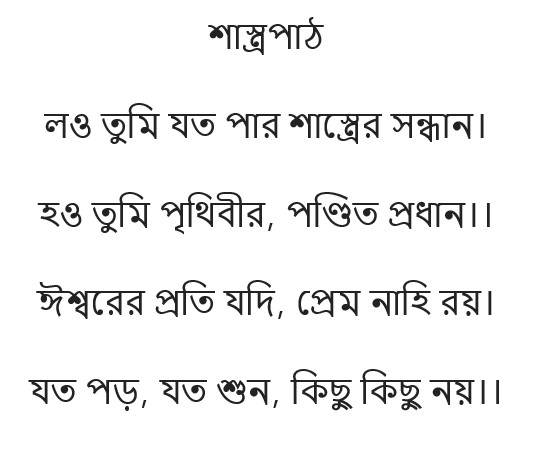
1. Let’s assume you are an ‘abcedminded’ human reader like the one Joyce anticipates in Finnegans Wake (1939): trained in the Latinate writing system and existentially immersed primarily in the English language and at least one of its many cultures. For you, the text above is unreadable. In what sense?

Not illegible, as if you’re encountering something badly digitized.

Not boring, as if it is insufficiently engaging.

Not inscrutable, as if this is a gnomic remark.

Not corrupted, as if you’re an AI machine blocked from extracting scrambled data.

Unreadable for you in the sense that the writing is inaccessible, whether seen as a string of letters making up individual words, as graphemes representing phonemes, or as meaningful phoneme-grapheme complexes. Perhaps, after a bit, you start discerning individual letter-shapes (ও, say or, ত), then noticing spaces between the words (making the first line 5 words), maybe you even infer from the layout (title and 4 lines) that this is probably a poem. Bear in mind that readers trained in this language and script would grasp all these things as readily as you and they might read the expression in this 😊.

2. Given the advances in machine translation, especially since the deep learning revolution of the 2010s, you need not of course feel at a loss for too long. You could begin by turning to Google translate, which, after automatically detecting Bengali, currently offers this translation:

Scripture reading
Search the scriptures as much as you can.
Be thou the world’s learned head.
If there is no love for God.
As much as you read, as much as you listen, nothing.

If you listen to Google’s female AI voicing of the original, you may pick up the rhymes, which make pairs of the four lines (aa, bb), contributing to the poem’s simple song-, even nursery-rhyme-like, sound in Bengali (none of which makes the transfer to Google English). Google’s translation was unchanged in 2023.

3. There are options other than Google, however. Though Deep-L, which claims to be ‘the world’s most accurate translator’, doesn’t currently support Bengali, GPT-3, the latest (2020) iteration of OpenAI’s powerful text generating language model, had no difficulty with the task, given the simple prompt ‘Translate this into English.’

Science Class
Do as much research as you can.
Be the chief of the world, the head of the scholars.
If there is no love for God, nothing is learned.
No matter how much is read and heard, nothing is known.

Subsequent regenerations produced ‘You are the Earth’s chief Pandit’ for the second line, and ‘No matter how much you study or listen, it won’t help’ for the last. This was GPT-3 in 2022. Here is GPT-4 (ChatGPT’s improved sibling) a year later:

Study of Scripture
Search as much as you can in the scripture.
Become the greatest scholar of the world.
If there is no love for God,
No matter how much you read or hear, it’s all in vain.

GPT-4 also concluded with this comment: ‘Please note that this is a loose translation and is aimed at preserving the meaning rather than the exact structure and rhyme of the original Bengali poem. Translation of poetry often involves balancing the need to remain faithful to the original text with the need to create a version that is enjoyable and meaningful in the target language.’

4. So how do the latest machines compare to human translators? As it happens, the English-language Indian poet Arvind Krishna Mehrotra has recently been collaborating with the Indian scholar Rosinka Chaudhuri on a project to bring a series of poems by the 19th-century Bengali poet Ishwar Gupta (1812-59) into English for the first time, including শাস্ত্রপাঠ (Sastrapath), which they render as ‘Reading Scriptures.’ The collaboration involved an extended email correspondence and an iterative process of drafting and redrafting, producing 10 English versions in all. I’ll focus on Chaudhuri’s literal rendering of the original Bengali (A), which Mehrotra (who has Hindi but not Bengali) then used as the basis for the evolving English drafts, the last of which (J) appears below the literal version.

A. Search for the [meaning of] the shastras as much as you want
Become the Chief Pandit of the world.
If you have no love for Iswar [however]
What you read, what you hear, comes to nothing at all.
(Chaudhuri)

J. Pore over scriptures as much as you want,
become chief of pundits,
but without Ishwar in your heart
what you read, what you listen to, comes to naught.
(Chaudhuri/Mehrotra)

Much can be said about the many large and small choices made in the process of turning A into J (for all the versions see below). Most notable, especially in comparison with the Google and GPT-3 versions, are the desire to find a viable contemporary English idiom/voice, the incorporation of rhyme, now simplified as a(a)aa, and the conspicuous decision to keep ‘Is(h)war’ (pronounced ‘Ishwor’). As the translators explain in a footnote to the published version, Gupta was punning on his first name as ‘Ishwar means “god” in Bengali as well as in most North Indian languages.’ They could have added that Gupta means ‘hidden’ and ‘secret’ in Sanskrit, giving him more scope for mischievous play on his name (‘hidden God’).

5. Do these differences matter? In a fundamental, deeply philosophical sense, yes because they tell us something about the ways in which (written) languages exist as vast digital corpora for the likes of Google and GPT-3 and as highly individual, historically lived experiences for the humans for whom the process of translating a 19th-century Bengali poem today is as much a cultural as it is a linguistic challenge.

6. Despite all the progress made in the last decade, the machines still cannot manage the playful equivocation at the heart of ‘Reading Scriptures’. Yet it is not as if they escape the cultural challenges of translation, treating it simply as a rule-governed linguistic process, finding statistical correspondences between written languages, for example. Inevitably, since there is no culture-free language, their correlations have cultural consequences too.

6.1 For the machines, ‘Reading Scriptures’ is a relatively uncomplicated devotional poem, something like a Bengali/Hindu version of 2 Corinthians 3:6: a warning to pundits/Pharisees who fail to grasp the true/living ‘spirit’ of religious piety because they are too preoccupied with the superficial/dead ‘letter.’ The Sanskrit word ‘shastra’ (scripture/learned treatise) neatly captures the blend of ‘manual, book, or treatise’ and ‘rule, law, or precept’, as in the English phrase ‘letter of the law’.

6.2 By contrast, for Chaudhuri and Mehrotra, these four lines constitute a knowingly crafted, even crafty example of a double poem which is devotional, like 2 Cor. 3:6, and anti-devotional, like Finnegans Wake. Without Ishwar in your heart, Gupta, the modernizing, satirical, very idiosyncratic Hindu-reformer and sly poetic celebrator of earthly life, says, referring not to God but to his own poetic oeuvre, anything you learn through reading or listening will amount to nothing. In short, it is not the divine spirt of the shastras/scriptures but the endlessly generative, secular letter, as practised by Gupta and later Joyce, that giveth life.

7. As this example shows, we still need human translators to see this. By contrast, the machines’ linguistic correlations confirm Douglas Summers-Hay’s apt description of GPT-3 as ‘an improv actor who…has never left home but only read about the world in books.’ Will this always be the case? Your guess is as good as mine, though, as we learn more about the way languages (and writing) evolve digitally and bio-culturally, I suspect differences will always remain, even as the boundaries become increasingly blurred.

___________________________________

Thanks to Arvind Krishna Mehrotra and Rosinka Chaudhuri for permission to reproduce their draft translations of ‘Reading Scriptures’ here. You may not reproduce them without seeking further permission. If you wish to quote them for academic purposes, please reference this post. Their workings are especially valuable, as these are impossible to track in deep learning AI systems. Their workings remain a mystery, even for their creators. 

For more about Ishwar Gupta, see Rosinka Chaudhuri, The Literary Thing: History, Poetry and the Making of a Modern Literary Culture (Oxford University Press, 2013; Peter Lang, 2014), especially chapter 2.

For more examples of Mehrotra’s creative-translation work, see his Collected Poems (Shearsman Books, 2022) and Ghalib: A Diary (New Walk, 2022), the latter is an original poem based in part on a translation.

For more on GPT-3, see Gary Marcus and Ernest Davis, ‘GPT-3, Bloviator: OpenAI’s language generator has no idea what it’s talking about‘, MIT Technology Review, 22 August 2020; and Luciano Floridi and Massimo Chiriatti Massimo, ‘GPT‐3: Its Nature, Scope, Limits, and Consequences‘, 1 November 2020, revised March 2022. 

Drafts

Sastrapath (Romanized version)
Lao tume jata paro śastrer sandhan,
Hao tumi prithibir, pandit pradhan.
Iswarer prati jadi, prem nahi roy
Jata para, jata śuno, kichhu kichhu noy.

Reading the Scriptures (literal)
A. Search for the [meaning of] the shastras as much as you want
Become the Chief Pandit of the world.
If you have no love for Iswar [however]
What you read, what you hear, comes to nothing at all.

Reading Scriptures

B. Look for meaning in scriptures as much as you want,
Become Head Pundit to the world,
But if you have no love for Ishwar,
What you read and what you hear will come to nought.

C. Read scriptures as much as you want/like,
become chief of pundits,
but without Ishwar in your heart
what you read, what you listen, comes to nought.

D. Read scriptures for all it’s worth,
become chief of pundits,
but if you don’t have Ishwar in your heart
what you read, what you listen, comes to nought.

E. Pore over scriptures for all they’re worth,
become chief pundit to the world,
but if you don’t have Ishwar in your heart
what you read, what you listen, comes to nought.

F. Pore over scriptures for all they’re worth,
become chief pundit to the world,
but if you don’t have Ishwar in your heart
everything that you read or listen comes to nought.

G. Pore over scriptures for all they’re worth,
become chief pundit to the world,
but unless there’s Ishwar in your heart
but unless Ishwar resides in your heart
everything that you read or listen comes to nought.

H. Pore over scriptures as much as you want,
become chief pundit to the world,
but unless Ishwar resides in your heart
but if Ishwar doesn’t reside in your heart
everything that you read or listen comes to nothing.

I. Pore over scriptures as much as you want,
become chief pundit to the world,
but if Ishwar doesn’t reside in your heart
everything that you read or listen comes to nothing.

J. Pore over scriptures as much as you want,
become chief of pundits,
but without Ishwar in your heart
what you read, what you listen to, comes to nought.